Education

The St. Irenaeus Institute for Catholic Thought

The St. Irenaeus Institute for Catholic Thought was newly incorporated and its vision was still crystallizing. With a first public fundraising event on the horizon and a growing sense of what the Institute could become, the Insitute needed a brand and web presence that could lead the mission boldly forward, and invite others in.

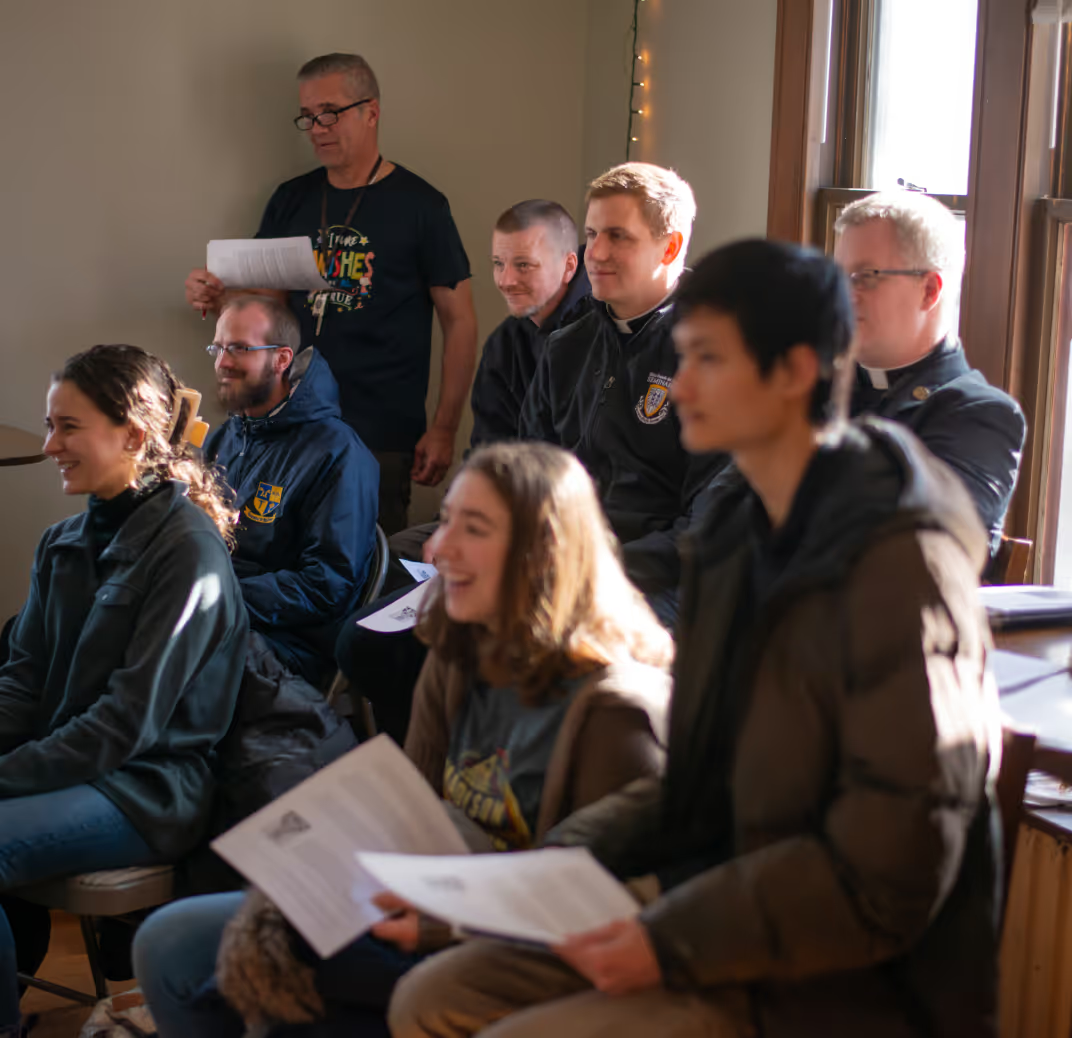
Group of people sitting indoors, some holding papers, smiling and engaging in a discussion near a window with natural light.

The context

The St. Irenaeus Institute for Catholic Thought grew out of a grassroots response to the desire for deeper intellectual formation in the Catholic community in Milwaukee, Wisconsin. The Institute serves students, scholars, Catholic priests, and lay Catholics throughout the Archdiocese of Milwaukee, through lectures, seminars, and ongoing programs rooted in the patristic heritage of the Church. A member of the In Lumine Network, the Institute has grown from a small reading group into a recognized center for Catholic intellectual formation in the region.

The process

My engagement with the Institute began in a unique way, with a pro bono brand consultation out of a genuine interest in the mission. These early foundational conversations became the seedbed for a strong, clear-eyed mission and vision, and an understanding of how to communicate those principles outward. Months later, when leadership was ready to invest in more ambitious strategic and creative initiatives, the shared clarity around the Institute's vision, audience, and direction made a formal partnership a natural choice.

Early positioning work was critical to uncover and define the unique space the Institute meant to occupy. Importantly, the wider category was populated with numerous players who had been around for decades, if not centuries. It was important for the Institute to both align with, and break away from these players. But the Institute's mission wasn't to replicate what any of them were doing. Where those institutions tend to operate within their own sphere, the Church on one side and the academy on the other, the Institute exists specifically to bridge that gap, bringing those two worlds into genuine conversation and building a network of people and communities that spans both. That positioning required a brand capable of signaling credibility to both audiences — serious enough for scholars, accessible enough for laypeople, and distinct enough to carve out its own place in a crowded field.

The Institute's first public fundraising gathering was approaching, and supporters, donors, and prospective partners would be forming their first impressions of the organization. Without a visual brand--and more critically, without a website and online giving infrastructure, the Institute would not be positioned to make the most of this critical milestone.

Our prior foundational work honing mission, vision, values, and positioning laid the groundwork for an authentic visual identity and high-level website strategy. Specifically, our early conversations uncovered deep insight into the Institute's major audience groups, and what those people needed to see and feel in order to join the SII community.

Brand guidelines for St. Irenaeus Institute, showing logos, color palette of red, orange, brown, dark blue, and cream, and custom icons of a dome, dove, quill, and cross.

As a newly-formed nonprofit, it was important to develop a brand system that respected both their objectives and their resources. We developed a custom scope for brand work to ensure a robust and flexible brand that worked with their financial picture. Key to this strategy was the choice to forgo logo development in favor of a simple but effective logotype, with a path for full logo development at a later stage. The inclusion of custom brand illustrations added a sense of legitmacy and esteem, and accompanying brand fonts and colors rounded out the suite to construct a well-rounded brand presence.

With that valuable insight into their audience groups, as well as their unique position in their category, we crafted a visual identity that was fresh, energizing and hopeful--signalling their forward-looking and contemporary approach in a space that tended towards tired and technical. Just as their mission seeks to bridge a gap between two distinct groups, the visual articulation of the brand does that same bridge-building.

From there, website architecture, wireframing, and full Webflow website development followed, with copywriting guidance woven throughout. With a rapidly changing calendar of programs and events, we agreed that a custom CMS architecture would be a powerful tool to empower the small but mighty team. With this custom content system in place, updates to program and event details could be managed internally, without using up precious resources. But the website was not just a pretty gadget--we focused on maximizing its potential to draw supporters and financial investment. I guided the team in selecting a donation platform suited to their needs and facilitated web integration, leading to donations within the first week of launch. An integrated HubSpot flow unlocked a powerful email list management strategy, and Google Analytics setup and training before launch meant the team could track outcomes meaningfully from day one.

Knowing that website launch is not the true measure of project success, I provided 1:1 training so the team could make edits confidently—and they have been ever since. The team has been able to keep the website up-to-date on program developments, and a long-term hosting and maintenance partnership ensures that larger sitewide maintenance is handled proactively.

Two years later, the brand is still gaining positive responses, and has grown in esteem alongside the nonprofit it represents. After co-hosting a major event that attracted participants from across the nation, the Institute experienced greater traffic, a rise in search volume, and an impressive estimated 70%+ of traffic garnered from organic search. With traffic in the steady thousands per month, what started as a "backroom pamphlet situation" has evolved into an organization and brand that can stand proudly alongside others that have been in the category for decades.
Then / Now

Then

Conviction without clarity

The Institute's mission was felt deeply by its leadership, but wasn't fully articulated. There was nothing to hand someone and say: this is what we're building.

No "face of the brand"

As a newly incorporated nonprofit, the organization had no brand to speak of --no logo, no website, and no communications materials to help them stay in mind.

DIY communications

A communications strategy that signalled "scrappy startup": Updates going out via a single team member's email to a small program group. No scalable channel for reaching a wider audience.

No giving pathway

Critically, supporters who wanted to give had no digital mechanism to do so—an urgent gap heading into a first public fundraising event.

Vision outpacing brand

The Institute's growing ambitions and vision had no outward embodiment, leading to a potential clash between what people were hearing about the Institute and what they were seeing.

Now

A team who shares the website as proudly as they share their mission

The Institute's purpose is now fully expressed—in words, in brand, in a web presence that reflects the ethos of the Institute and gives leadership something to point to with pride.

A brand built for the long game

A logotype and brand system designed to meet current constraints while laying the foundation for future brand development . Forward-looking from day one.

Dedicated communications system

HubSpot email integration and newsletter signup funnels converting event attendees and website visitors into long-term subscribers and supporters.

Donations on Day One

Online giving platform integrated and live before the first event meant first donations came in within the first week of launch.

Trust-building brand & website

With decidedly positive responses from supporters, scholars, and prospective partners, a presence that signals legitimacy and earns confidence on sight.

Capabilities

  • Brand Strategy
  • Audience research
  • Brand Identity
  • Website Architecture
  • Webcopy Workshopping
  • Web Design
  • Webflow Web Development
  • Custom CMS build
  • Online giving web integration
  • Google Analytics
  • Website Maintenance

"A highlight for me was our brand strategy meeting. The way Siena prepared for that meeting opened up a conversation that gave me a vision for this institute that I didn't encounter in other contexts — and really energized me. By the time we were ready to invest more substantially, it was obvious that I wanted to work with her. I was just very impressed by the work she;d done, and by her understanding of our goals as an organization. Our conversations along the way gave me a lot of trust and confidence that Siena was going to be able to deliver to the scale we desired."

Aaron Ebert, Executive Director

The results

The Institute walked into its first public event with a brand and web presence that held up under scrutiny. That credibility had immediate, tangible consequences: Online donations came in within the first week of launch. Newsletter signups and inquiry form submissions followed within the first month. Relationships with supporters, scholars, and prospective partners got off on the right foot from day one.

Where many early-stage nonprofits assume limited resources mean a minimal brand approach, the Institute chose differently, investing thoughtfully in the right brand and web infrastructure at the startup stage, and generating momentum because of it. Instead of circling back later to repair a brand that was never built to last, they've been building forward ever since.

Since it's public launch the Institute continues to build a name for itself, and has carved out it's own unique place, standing in conversation with historic institutions decades, if not centuries, older than it.

"We've gone from sort of the back-room pamphlets approach—shoestring budget, squeezing hours here and there—to developing something that seems very professional and very legitimate. I not only will happily share the website, but I eagerly share it with people I know. People who will look at the website and think: this is legitimate. This is impressive. This is on par with other substantial organizations."

Aaron Ebert, Executive Director

Key Insights

Your first public moment is a brand moment, regardless if you're ready for it.

The Institute's first fundraising gathering was a given. The question was whether the brand and infrastructure would be ready to meet it. And a strong brand presence at a first event doesn't just shape donor perception, it shapes the internal team's own confidence and sense of legitimacy. First impressions compound: that initial positive engagement invites another, and a brand that isn't ready for that second or third touchpoint will not stand up to a brand that is. Developing a strong, layered brand strategy meant the Institute was ready and waiting for each point of contact.

Scale scope without losing sight of major goals

Overspending on brand at the wrong moment is a real risk, but underspending without a strategy is worse. It leads to outputs that don't serve the organization's goals and eventually have to be replaced, compounding the original loss. When resources are slim, a more effective approach gets clear on what success actually requires, then builds the minimum viable solution that gets there. For the Institute, that meant forgoing full logo development in favor of a strong logotype, a curated illustration set, and a brand system built to grow. Every decision was deliberate, nothing was wasted, and when the time comes to invest in the next phase of brand development, they won't be starting over, they'll be building on something that already works.

Project success is measured in capacity built

Whether it's a brand engagement, a marketing overhaul, or a web project, the real outcome isn't the deliverable—it's the capacity it creates. Any major project that doesn't result in a new level of operational leverage has prioritized one-off milestones over lasting momentum. Oftentimes the breakdown happens at handoff: when strategic and creative outputs are too complex to fully own, teams default to old systems, leaving the organization with significant resource losses and no real change. With the Institute's particular constraints, every solution was built with that in mind. A custom CMS kept the digital presence current without consuming precious staff time. A light but comprehensive brand suite gave a small, changing team everything it needed to show up consistently as the Institute's reach grew.

Market positioning isn't just for for-profits

To build a brand that could hold its own alongside established institutions, we first needed a clear picture of the landscape—who the major players were, what space they occupied, and where the Institute fit among them. We discovered the areas that we had to emulate and the areas where we had to stand apart, which led to a brand and story that earned positive responses from varied audience groups. Uncovering where your organization stands relative to others isn't a corporate exercise, it's a necessary step to determine what makes your organization worth choosing, and how you communicate that.

Your mission deserves a brand that speaks its language. Let's build it.

Group of people sitting indoors, some holding papers, smiling and engaging in a discussion near a window with natural light.